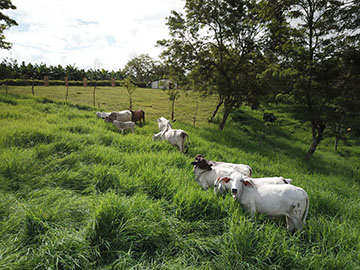
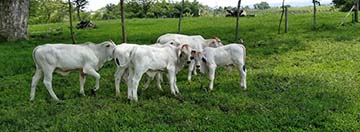
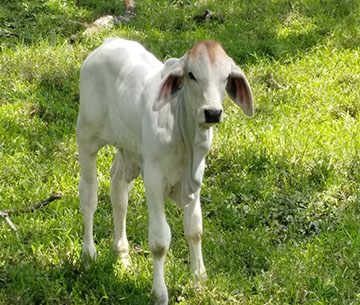
We proudly present images of our bulls, cows and calves in their open, free, and natural settings. Here is a 5-month old calf already strong and stocky from grass and full milk feeding.
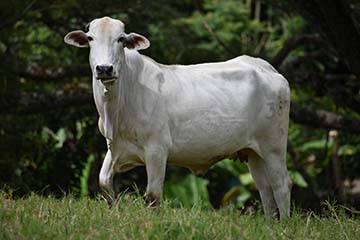
We select cows by their qualities to allow us to produce calves that will grow strong, healthy and well fed. We keep strict controls of the genealogy of each cow and their productivity.
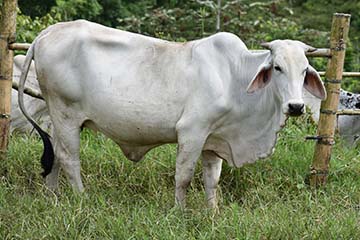
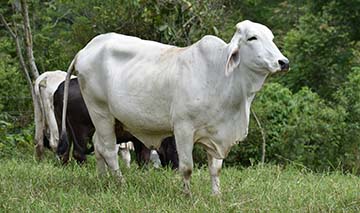
Because our market niche is the production of calves that others will raise, quality control of the mothers is esential: we keep cows that are long, tall, and produce enough milk to feed their calves, like the one pictured here.
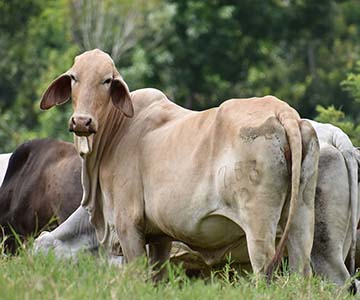
This cow in Serrano's herd shows signs of an advance gestation. Cattle gestation lasts about 280 days, or 9 months. We do not use artificial insemination, so the cattle live their natural reproductive cycle.
Serrano is for sure our best bull. He comes from a prestigious farm in Santander and is so called in honor of that farm's owner. Here he is with his cows. All are feeding on grass and roaming freely in the pastures.
Besides Brahman, we also have BON (Blanco Oreji Negro) bulls. This cow is in the herd of our BON. F1s from the crossing of BON and Brahman are strong and heavy. This cow is in the herd of our BON bull.
At La Ceiba we pay attention to the physical traits of the females when selecting our stock, and we only keep those cows such as this one that show the best traits of their race.
Crossing BON and Brahman produces calves of different colors. The father's race, though, as the name of the race suggests, has white skin and black ears.
Even though La Ceiba is not a milk farm, we do milk a few cows to distribute the milk free of charge among the workers who live on the premises, and particularly to those families that have young children. This picture shows our milk cows.
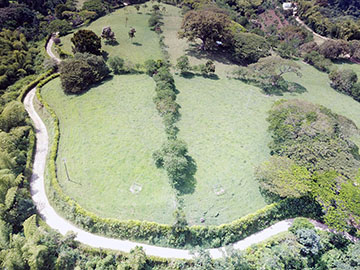
We constantky fertilize pastures with natural fertilizers so that we can keep them in the best conditions to provide natural and healthy feed for our cattle.
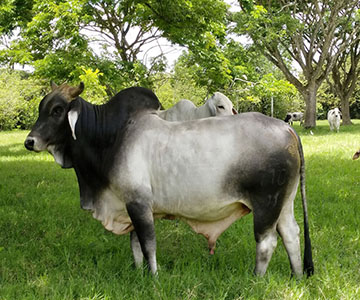
A slightly different kind of Brahman than Serrano, this is another one of our excellent bulls. All our bulls are relatively young, and the herd as a whole is regularly visited by our excellent veterinarian woman, and we follow the vaccination plans of the Instituto Colombiano Agropecuario (ICA).
Except for a few calves that share their mothers' milk with children on the farm, all our calves are fed on grass and all of their mothers' milk.
This beautiful calf is about 2 weeks old, but is already showing the best traits of its race. We keep calves till the day they are weanned, approximately at the age of 7 months.
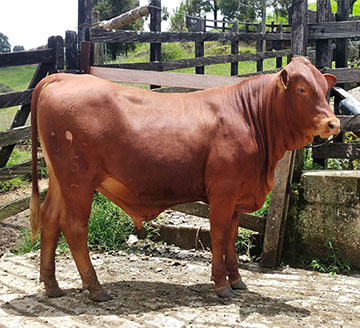
Francisco is our youngest bull. We took this picture the day we bought him at a famous farm in Fredonia, Antioquia. He is a beautiful Senepol male, and with him we are introducing a new variety of F1s. We expect Francisco's first calves to be born around March 2020.
Serrano, The Bull!.
This is a Senepol cow. She came to our farm in the womb of a cow we bought and has already had two births since. Her sons are crossed with our BON. Senepol calves are very small when they are born, but by the time they leave the farm, they are among the biggest and heaviest.
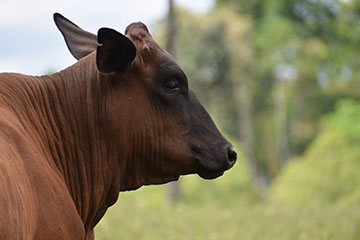
Typical head of a Senepol cow.
All our pastures are fertilized with natural fertilizers, and every year we plant new trees for shade and protection of the herds. We planted two native trees, a flamboyan and a saman, here towards the end of 2018.